OTR Tire Industry Faces Infrastructure Cliff, Tariff Uncertainty in 2026
...

“After switching to AT tires, driving on the highway felt like piloting a plane—all buzzing and droning. City fuel consumption skyrocketed straight to 18 liters per 100 km, and even braking in the rain became a nerve-wracking experience.” — This is the honest feedback from an owner of a new-model Prado. Within the off-roading community, the notion that “AT tires are the universal solution” has long been deeply ingrained; many novices even make it a default practice to swap to AT tires the moment they take delivery of a new vehicle. However, an increasing number of urban commuters are discovering that this “all-terrain” gear brings not peace of mind, but rather persistent noise, increased fuel consumption, and compromises in ride comfort. Are AT tires truly suitable for the majority of drivers? The answer may be more complex than you imagine.
Advantages and Costs Go Hand in Hand
AT tires are not a “one-tire-fits-all” universal remedy for traversing the globe, but rather the result of a deliberate trade-off in performance characteristics. While their advantages are irreplaceable in specific scenarios, they also come with significant costs and drawbacks in the context of daily driving.
Scenarios Where They Excel
Costs and Limitations
Highway-Biased AT (e.g., Toyo Open Country A/T III, Toyo OPAT3): 70% highway / 30% off-road focus; emphasizes quiet operation and low rolling resistance, making it ideal for users who spend 90% of their time on city commutes with only occasional excursions.
Balanced AT (e.g., BFGoodrich KO2, Cooper AT3 LT): The standard “All-Terrain” option; strikes a balance between paved roads and unpaved surfaces, making it the top choice for most recreational off-road enthusiasts.
Off-Road-Biased AT (e.g., Mickey Thompson Baja Boss A/T): Offers 60% off-road performance with reinforced shoulders and enhanced puncture resistance; suitable for users who frequently traverse rough terrain but do not wish to completely sacrifice on-road drivability.
Are AT Tires Right for Most People?
AT Tires Are the Optimal Solution for the Vast Majority
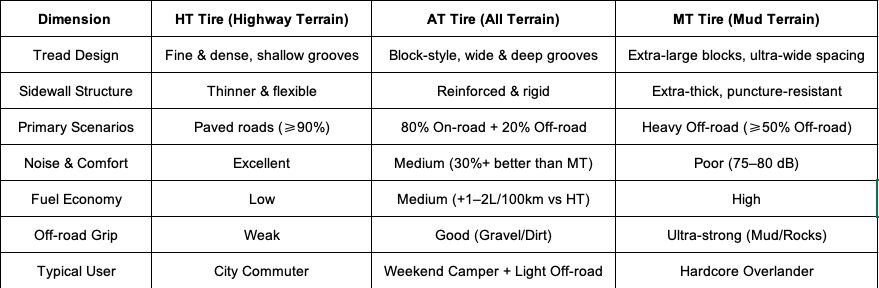
They cater to the mainstream usage scenario of 80% paved roads and 20% unpaved surfaces, covering the needs of both urban SUV owners and light off-roaders.
Compared to MT tires, they offer significant improvements in noise levels, fuel efficiency, and on-road comfort, ensuring you don’t have to make excessive compromises on your daily driving experience just to handle extreme conditions.
Technological advancements (such as those found in the Toyo Open Country A/T III or Blackbear Pro) are continuously narrowing the performance gap between AT tires and standard HT (Highway Terrain) tires on paved roads.
AT Tires Are Often Over-Hyped—Many People Don’t Actually Need Them
If more than 90% of your driving takes place on paved roads, switching to AT tires actually constitutes a performance downgrade, introducing tangible drawbacks such as increased noise, higher fuel consumption, and longer braking distances.
Blindly chasing a “rugged aesthetic” while ignoring actual driving requirements inevitably leads to a compromised overall ownership experience.
True hardcore off-road enthusiasts still require MT or RT tires, as AT tires simply lack the capability to handle extreme off-road scenarios.
The ultimate conclusion isn’t simply “should I choose AT tires or not,” but rather “which type of AT tire should I choose?”—or whether to “skip AT tires entirely.” The key lies in quantifying the percentage of your driving that takes place on unpaved surfaces:
Unpaved Roads ≤ 10% (Pure City Commuting): Stick with HT (Highway Terrain) tires. AT tires merely increase costs and compromise comfort; they are entirely unnecessary for most drivers.
10%–50% Unpaved Driving (Weekend Camping, Light Off-roading): Opt for highway-oriented or balanced-performance AT tires. Prioritize models featuring the Three-Peak Mountain Snowflake (3PMSF) certification and noise-reduction designs—such as the Toyo Open Country A/T III (OPA3G) or Cooper Discoverer AT3 LT.
≥50% Unpaved Driving (Frequent Rough Roads, Construction Sites, Serious Off-roading): Consider aggressive, off-road-oriented AT tires, or even step up directly to MT (Mud-Terrain) or RT (Rugged-Terrain) tires. In these scenarios, the on-road compromises inherent to AT tires become negligible; reliability and self-extrication capabilities are the paramount concerns.
Remember: when it comes to tires, there is no room for blind faith—only mileage matters. First, accurately calculate the actual percentage of unpaved roads you traverse annually. Only then should you decide whether to sacrifice 80% of your daily driving comfort for the sake of a mere 20% “possibility.” For the vast majority of drivers who truly want the best of both worlds—on-road comfort and off-road capability—a carefully selected highway-oriented AT tire may well be the most rational solution.
 06Mar
06Mar