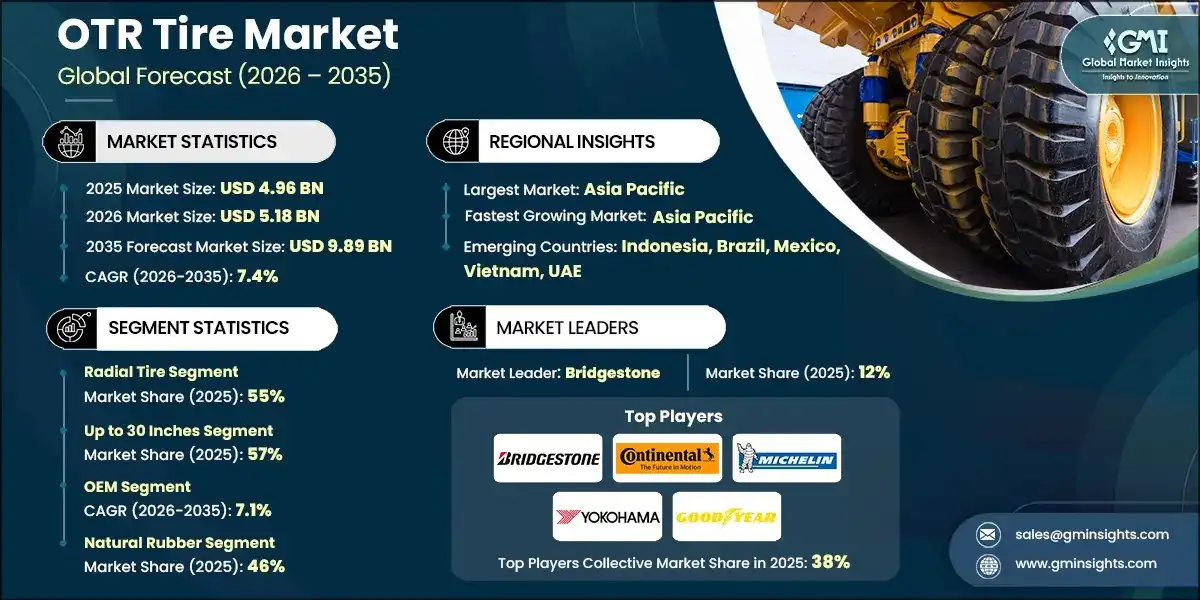
As per Market Research Future Analysis, the OTR Tire Market growth is projected to reach USD 47.06 billion, at a 5.61% CAGR by driving industry size, share, top company analysis, segments research, trends, and forecast report from 2025 to 2035.
Market Overview
Off-the-road (OTR) tires, also known as off-highway tires, are specialized pneumatic tires designed for heavy-duty vehicles and equipment used in mining, construction, agriculture, ports, and industrial applications. Unlike standard highway tires, OTR tires are engineered to withstand extreme loads, abrasive surfaces, harsh terrains, and punishing operating conditions. They are characterized by deep, aggressive tread patterns for maximum traction, reinforced sidewalls to resist cuts and impacts, and specialized rubber compounds that resist heat buildup during low-speed, high-torque operations. OTR tires encompass a vast size range, from those fitted on large agricultural tractors and earthmoving equipment to the giant tires used on ultra-class mining haul trucks that can stand over four meters tall and weigh several tons each. These tires are mission-critical components, as equipment downtime due to tire failure in remote mining or construction sites can result in massive productivity losses.
The growth trajectory of the OTR tire market is fundamentally tied to the health and expansion of global commodities extraction, infrastructure development, and large-scale industrial activity. The primary growth driver is the sustained demand for minerals, metals, and fossil fuels, which drives mining activity worldwide. As existing mines deplete and operators move to deeper or more remote deposits, the demand for larger, more capable haul trucks and correspondingly larger tires increases. Infrastructure development, including road construction, dam building, urban expansion, and industrial park development, generates significant demand for earthmoving equipment and the tires that support them. The agricultural sector’s ongoing mechanization, particularly in developing regions, drives demand for agricultural OTR tires for tractors, harvesters, and sprayers. Port expansion and global trade growth sustain demand for port handling equipment tires.
Key industry trends include the relentless progression towards larger tire sizes for ultra-class mining trucks, as operators seek economies of scale in material movement. The adoption of radial tire technology over traditional bias-ply construction continues to accelerate across most OTR segments, driven by radial tires’ superior heat dissipation, longer tread life, lower rolling resistance, and improved fuel efficiency. Another significant trend is the growth of tire management solutions, including telemetry and pressure monitoring systems, that allow operators to optimize tire life, reduce downtime, and manage the substantial investment represented by OTR tires. The retreading of OTR tires, particularly in mining and large-scale construction, is a major trend, offering significant cost savings and environmental benefits by extending casing life through multiple tread lives.
Technological developments in OTR tires are focused on extending tire life, improving cut and chip resistance, and reducing operating temperatures. Advanced computer-aided engineering (CAE) and finite element analysis (FEA) allow manufacturers to optimize tread patterns, internal structures, and compound formulations for specific applications. The development of new synthetic and natural rubber compounds, often incorporating specialized fillers and reinforcements, enhances resistance to cuts, abrasion, and heat. Innovations in bead construction and casing design improve durability and retreadability. The integration of RFID tags and sensors within tires for identification, pressure monitoring, and temperature tracking is becoming more common, enabling data-driven tire management.
Policy and regulatory frameworks influence the OTR tire market in several ways. Mining safety regulations, particularly regarding equipment maintenance and tire condition, drive replacement demand and influence purchasing decisions. Environmental regulations governing mining operations and emissions can indirectly affect tire specifications, with fuel-efficient radial tires offering environmental benefits. Trade policies, including anti-dumping duties on OTR tires in various jurisdictions, have historically shaped global trade flows and manufacturing locations. Regulations concerning tire imports for mining and construction projects in developing countries can create market barriers or opportunities.
The demand outlook for the OTR tire market is positive, driven by the fundamental need for commodities and infrastructure. The Original Equipment Manufacturer (OEM) segment will grow in tandem with equipment production, which is itself driven by mining company capital expenditure cycles and construction activity. The replacement market, however, dominates OTR tire volume and value, as tires wear out relatively quickly under severe service conditions and must be replaced multiple times over a machine’s life. The mining sector, with its high-intensity operations and massive tire sizes, represents the highest-value segment. Construction and infrastructure development provide steady, geographically diverse demand. As equipment becomes larger and more sophisticated, the demand for high-performance, durable tires with long service life and good retreadability will intensify.
📍 Get Free Sample Report for Detailed Market Insights:
https://www.marketresearchfuture.com/sample_request/27225
Market Segmentation
By Tire Type
The market is segmented into Radial and Bias (Cross-Ply) tires. Radial tires, with their construction featuring steel belts running perpendicular to the tread, dominate the high-value mining and large earthmoving segments. They offer superior heat dissipation at higher speeds, longer tread life, better fuel efficiency, and improved operator comfort. Radial technology is essential for the largest ultra-class mining trucks operating over long hauls. Bias tires, constructed with multiple layers of rubber-coated ply cords crisscrossing at angles, remain significant in specific applications. They offer greater sidewall strength and cut resistance, making them suitable for severe service conditions in certain mining, construction, and port applications where speeds are low and impacts are frequent. Bias tires also dominate in smaller sizes and price-sensitive segments due to their lower initial cost.
By Application
Segmentation includes Mining, Construction, Industrial, and Agriculture. The mining segment represents the largest value share, encompassing tires for rigid and articulated dump trucks, wheel loaders, excavators, and underground mining equipment. These tires face the most extreme conditions, including massive loads, sharp rocks, and abrasive surfaces. The construction segment includes tires for equipment used in road building, site preparation, and general earthmoving, including graders, compactors, and skid-steer loaders. The industrial segment covers tires for port handling equipment (reach stackers, container handlers), forklifts, and material handling equipment in factories and warehouses. The agriculture segment includes tires for tractors, combines, sprayers, and other farm equipment, with specialized designs for different soil conditions and applications.
By Equipment Type
This includes Loaders, Dozers, Excavators, Graders, Compactors, Agricultural Tractors, and others. Loader tires, used on wheel loaders in mining, construction, and industrial applications, require deep treads for traction and reinforced sidewalls for durability. Dozer tires, primarily for crawler dozers, are specialized for severe undercarriage applications. Excavator tires are less common, as many excavators are track-mounted, but wheeled excavators require robust tires. Grader tires face specific demands for blade control and even wear. Compactor tires are designed for high loads and smooth surfaces. Agricultural tractor tires require deep lugs for traction in fields and must transition to road travel. Each equipment type imposes unique demands on tire design and compound formulation.
By Sales Channel
The market is divided into Original Equipment Manufacturer (OEM) and Aftermarket. The OEM segment supplies tires to equipment manufacturers for fitment on new machines. This segment is driven by global equipment production volumes and specifications set by manufacturers in consultation with tire suppliers. The aftermarket segment dominates OTR tire sales, encompassing replacement tires sold through distributors, dealers, and directly to end-users. Given the wear rates of OTR tires in severe applications, a single machine may consume multiple sets of tires over its operational life. The aftermarket also includes retread services, which are significant in mining and large-scale construction. The distribution channel for OTR tires is specialized, requiring technical expertise and the ability to handle large, heavy products.
By Rim Size
Segmentation includes up to 29 inches, 29 to 49 inches, and above 49 inches. The up to 29-inch segment covers smaller OTR tires used in compact construction equipment, agricultural machinery, and industrial applications. The 29 to 49-inch segment includes tires for medium to large wheel loaders, articulated dump trucks, and agricultural equipment. The above 49-inch segment comprises the largest OTR tires, used primarily in ultra-class mining haul trucks and large earthmoving equipment. This segment, while smallest in unit volume, represents the highest value per tire and is technologically the most demanding, with tires costing tens of thousands of dollars each.
🛒 You can buy this market report at:
https://www.marketresearchfuture.com/checkout?currency=one_user-USD&report_id=27225
Regional Analysis
North America
North America is a major OTR tire market, driven by significant mining activity in the United States and Canada, including coal, copper, gold, and oil sands operations. The region’s construction industry, supported by infrastructure spending and commercial development, generates steady demand. The United States is a large agricultural market, with the Midwest’s farming operations requiring substantial agricultural OTR tires. The region is characterized by a preference for high-quality radial tires, a strong emphasis on tire management and retreading, and a well-developed distribution network. Environmental and safety regulations in mining influence tire specifications and replacement cycles.
Europe
Europe is a mature OTR tire market with significant demand from construction, industrial, and agricultural sectors. Mining activity, while present in countries like Sweden, Finland, and Poland, is less dominant than in other regions. The construction sector, supported by infrastructure maintenance and urban development, is a steady demand source. European agriculture, with its large, mechanized farms, requires substantial agricultural tires. The region is technologically advanced, with strong emphasis on fuel efficiency, environmental sustainability, and retreading. European manufacturers are leaders in OTR tire technology, particularly in agricultural and industrial segments.
Asia-Pacific
Asia-Pacific is the largest and fastest-growing OTR tire market, driven by massive mining industries in Australia, China, and Indonesia, and unprecedented infrastructure development across the region. Australia’s mining sector, including iron ore, coal, and gold, demands large quantities of ultra-class mining tires. China, as the world’s largest producer of many minerals and the site of enormous infrastructure projects, generates massive OTR tire demand across all segments. India’s growing mining industry and ambitious infrastructure development create substantial opportunities. Southeast Asian nations, with their mining and construction activities, contribute to regional growth. The region is also a major manufacturing hub for OTR tires, with numerous domestic and international producers.
Rest of the World
Markets in Latin America, the Middle East, and Africa are significant OTR tire consumers, driven by resource extraction and infrastructure development. Latin America, particularly Brazil, Chile, and Peru, has substantial mining operations (copper, iron ore, gold) that demand large OTR tires. The Middle East’s construction boom, particularly in the Gulf states, generates significant demand for construction equipment tires. Africa’s mining industry, spanning South Africa, the Democratic Republic of Congo, Zambia, and Ghana, is a major consumer of OTR tires, with operations often in remote locations where tire reliability is critical. These markets often rely on imports and face challenges related to logistics, tire service, and retreading infrastructure.
Competitive Landscape / Key Players
The OTR tire market is dominated by a small number of global giants alongside specialized regional players. Key companies include Michelin, Bridgestone Corporation, Goodyear Tire & Rubber Company, Continental AG, Yokohama Rubber Co., Ltd., Titan International, Inc., BKT (Balkrishna Industries Limited), Triangle Tyre Co., Ltd., Guizhou Tyre Co., Ltd., and Apollo Tyres Ltd. Michelin and Bridgestone are particularly dominant in the ultra-class mining tire segment, where technological expertise, service capability, and global availability are critical. Competition is based on tire durability, heat resistance, cut protection, retreadability, and total cost per hour of operation. Strategic developments include investments in manufacturing capacity for large radial tires, expansion of service networks in mining regions, acquisitions to gain market share or technology, and continuous R&D in compounds and structures. The ability to provide comprehensive tire management services, including on-site inspections, pressure monitoring, and retreading, is a key competitive differentiator in the mining segment.
Latest Industry News & Developments
Expansion of Giant Tire Production: Major manufacturers, including Michelin and Bridgestone, have announced capacity expansions for ultra-large OTR tires (63-inch and above) to meet growing demand from mining companies operating new-generation ultra-class haul trucks that require these massive tires.
Sustainable Material Initiatives: Industry leaders have announced progress in developing OTR tires with high percentages of sustainable and bio-sourced materials, responding to mining company sustainability goals and regulatory pressure for reduced environmental impact across the mining value chain.
Digital Tire Management Advancements: Several manufacturers have launched enhanced digital platforms for OTR tire management, integrating real-time pressure and temperature monitoring with predictive analytics to forecast tire life, optimize maintenance schedules, and reduce unplanned downtime in mining operations.
Market Challenges & Opportunities
Key Challenges include the extreme cyclicality of the mining industry, which creates volatile demand patterns that complicate production planning and inventory management for tire manufacturers. The enormous capital investment required for molds and production equipment for large OTR tires creates high barriers to entry and limits production flexibility. Raw material price volatility, particularly for natural rubber and specialty chemicals, impacts manufacturing costs. Logistics challenges, including the difficulty and expense of transporting giant tires to remote mining sites, add complexity. The concentration of ultra-large tire production among a few suppliers creates supply chain vulnerability for mining companies.
Emerging Opportunities are significant. The ongoing trend towards larger mining equipment creates persistent demand for even larger tires, with manufacturers competing to develop tires for new, bigger haul trucks. The expansion of mining into deeper and more remote deposits requires tires with enhanced durability and heat resistance. The growing adoption of tire management solutions and data analytics creates opportunities for value-added services beyond tire sales. The retreading market, particularly for large mining tires, offers substantial growth as operators seek to extend casing life and reduce costs. The development of tires for specialized applications, such as underground mining and electric mining equipment, presents niche opportunities.
Future Market Potential
The long-term potential of the OTR tire market is anchored in the fundamental human need for resources and infrastructure. As global population grows and developing economies industrialize, the demand for minerals, metals, and energy will persist, driving mining activity. Urbanization and infrastructure renewal will sustain construction activity. Agricultural mechanization will continue to advance. These enduring trends ensure that OTR tires will remain essential components of the global economy. The future will see continued technological advancement in tire compounds, structures, and digital integration, with tires becoming intelligent components that communicate their condition and predict their own failure. The push for sustainability will drive innovations in materials and retreading, creating circular economy models for these massive, resource-intensive products. The OTR tire of the future will be not just a consumable component but a data-generating asset managed for maximum total value over multiple lives.
To explore more market insights, visit us at:
https://www.marketresearchfuture.com/reports/otr-tire-market-27225
Final Market Summary
In summary, the OTR tire market is positioned for steady growth at a 5.61% CAGR, reaching USD 47.06 billion by 2035. This growth is fundamentally driven by the sustained global demand for minerals, the ongoing need for infrastructure development, and the continued mechanization of agriculture. The market is technologically demanding, with radial tires gaining share across most segments and the ultra-large mining tire category representing the pinnacle of tire engineering. Asia-Pacific leads in volume growth, while North America and Europe remain significant markets with mature service and retreading ecosystems. For manufacturers and suppliers, success requires mastering the technical challenges of extreme service conditions, managing the cyclicality of end-user industries, and developing comprehensive service and tire management capabilities that extend beyond the tire itself. The OTR tire market, while niche in unit volume, is critical to the global economy and will remain so for the foreseeable future.

 063 月
063 月
 063 月
063 月
 063 月
063 月
 063 月
063 月